
The Evolution of Artificial Intelligence: Transforming Industries in 2026
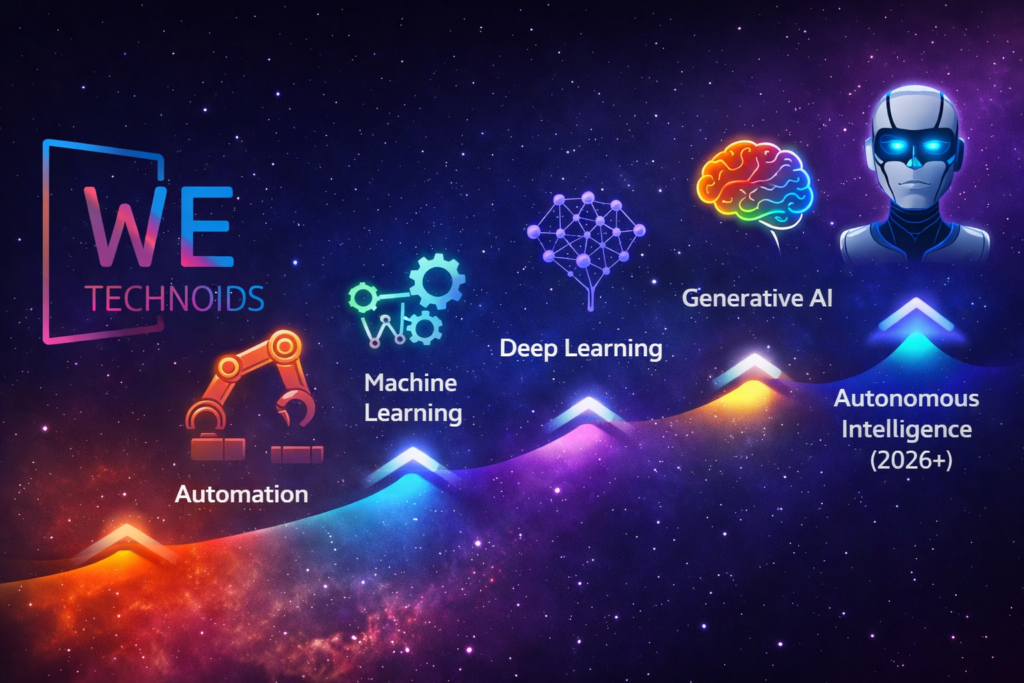
Artificial Intelligence in 2026 has moved far beyond simple automation and predictive analytics it has evolved into a deeply integrated technological infrastructure that now influences economic systems, enterprise operations, scientific research, digital society, and everyday human experiences at a scale never seen before. Unlike earlier stages of AI adoption where organizations implemented isolated use-cases such as chatbots, recommendation engines, or fraud detection models, modern AI ecosystems now operate as interconnected intelligence networks powered by large language models, multimodal models, autonomous decision engines, digital twins, edge-AI deployments, and adaptive learning systems. In 2026, AI has transitioned from being a support technology to becoming a strategic core capability that drives competitiveness, innovation, and industry transformation. With advancements in generative intelligence, self-optimizing systems, neuro-symbolic reasoning, and domain-specialized AI agents, organizations are not only automating workflows they are restructuring entire business architectures around intelligent decision-making, scalable automation, and human-AI collaboration. However, this evolution has also introduced complex challenges including governance, safety, ethics, data sovereignty, regulatory compliance, workforce transition, and social responsibility. The evolution of AI in 2026 is therefore not just technological it is structural, economic, and societal, reshaping how industries operate, innovate, and scale future growth.
AI in Business & Enterprise Operations
In 2026, enterprises have moved beyond task-level automation toward cognitive decision-making platforms where AI systems analyze markets, optimize resources, predict operational risks, and assist executives in strategic planning. Large Language Models are embedded across enterprise environments as virtual analysts, report generators, compliance advisors, customer engagement assistants, and knowledge intelligence engines that synthesize large information ecosystems into actionable insights. AI-driven analytics platforms integrate financial performance data, supply-chain behavior, workforce productivity, and market signals to support data-guided organizational strategy instead of intuition-based decision culture. Intelligent Process Automation now combines machine learning, workflow orchestration, digital twins, and autonomous monitoring to create adaptive business operations capable of responding to fluctuations in demand, logistics disruptions, or regulatory shifts in real time. Instead of static dashboards, enterprises rely on self-updating insight engines that continuously learn from operational data. The result is a transition from manual supervision toward AI-assisted management ecosystems, where human expertise focuses on judgment, ethics, creativity, negotiation, and leadership while AI systems handle large-scale pattern discovery, risk modeling, and rapid scenario simulation.
AI in Healthcare - Precision Medicine, Diagnostics & Intelligent Care Systems
Healthcare in 2026 has become one of the most deeply transformed AI-driven sectors, moving from generalized treatment models toward precision-based, data-guided medical ecosystems. AI-powered diagnostic models analyze radiology scans, pathology results, genomic sequences, wearable sensor data, and patient histories to assist clinicians in early disease detection, treatment recommendation, and personalized care planning. Multimodal AI systems integrate medical imaging with structured clinical records, improving diagnostic confidence across oncology, cardiology, neurology, and metabolic disorders. Digital health twins simulate patient-specific treatment outcomes, reducing trial-and-error decision making while improving care efficiency and clinical safety. AI-driven virtual health assistants support patient monitoring, medication adherence, appointment triaging, and symptom assessment extending healthcare accessibility to remote and underserved populations. Hospitals increasingly operate intelligent scheduling, supply management, and capacity optimization systems that reduce waiting times and prevent resource bottlenecks. However, healthcare AI evolution also requires strict governance addressing data privacy, regulatory validation, reliability testing, and ethical boundaries, ensuring that AI augments not replaces medical expertise. AI in 2026 is therefore redefining healthcare as a collaborative intelligence ecosystem where clinicians and AI systems work together to deliver safer, faster, and more personalized patient outcomes.
AI in Finance - Risk Intelligence, Automation & Hyper-Personalized Banking
Financial services have adopted AI in 2026 as the backbone of risk modeling, fraud detection, investment insights, compliance automation, and real-time transaction monitoring. Instead of rule-based systems, banks now deploy deep learning models capable of recognizing complex behavioral anomalies across massive transaction networks, helping prevent fraud and cyber-manipulation activities at earlier stages. Algorithmic trading systems integrate macro-economic indicators, sentiment analytics, news signals, and historical performance trends to support portfolio optimization and risk-adjusted investment strategies. Generative AI assistants explain financial reports, regulatory guidelines, and contract structures in human-readable form, reducing operational friction in compliance, auditing, and legal workflows. Customer banking shifts toward hyper-personalized financial advisory experiences, where AI recommends savings plans, credit options, spending insights, and financial wellness guidance tailored to individual behavior patterns. However, AI expansion introduces new responsibilities, including transparency in automated decisions, algorithmic fairness, and mitigation of systemic risk. In 2026, financial institutions recognize AI not merely as a productivity tool but as a critical infrastructure asset shaping stability, trust, and long-term financial resilience.
AI in Manufacturing -Smart Factories, Robotics & Predictive Operations
Manufacturing in 2026 has evolved into a fully connected Industry 4.0–5.0 environment powered by AI-driven robotics, digital twins, supply-chain intelligence, and predictive maintenance systems. Smart factories use sensor networks, machine vision, and real-time monitoring to detect equipment anomalies before failure occurs, significantly reducing downtime and operational waste. Autonomous robots collaborate with human workers in assembly, quality inspection, and logistics handling, improving production precision and workplace safety. AI-based demand forecasting models align production schedules with market behavior, reducing surplus inventory while increasing delivery reliability. Supply-chain ecosystems integrate transportation analytics, vendor reliability scoring, and geopolitical risk modeling to optimize sourcing strategies and prevent disruption cascades. Digital twin simulations replicate factory environments, enabling organizations to test process changes virtually before implementation. The manufacturing workforce transitions toward human-AI collaboration roles including robotics supervision, predictive systems engineering, and intelligent operations management. AI in 2026 has shifted industrial production from rigid mechanized systems to adaptive, learning-oriented manufacturing ecosystems capable of evolving alongside global economic shifts.
AI in Education - Personalized Learning & Intelligent Knowledge Systems
Education in 2026 is increasingly shaped by adaptive learning platforms, intelligent tutoring systems, and AI-driven content generation tools that personalize learning experiences based on cognitive pace, comprehension patterns, and knowledge gaps. Instead of standardized instruction models, learners engage with dynamic learning pathways where AI adjusts curriculum flow, assessment structures, and explanation depth according to individual progress. Intelligent tutoring agents provide real-time feedback, help clarify complex topics, and support skill acquisition in STEM, language learning, creativity, and vocational training. Educators use AI analytics to identify learner performance trends, attention patterns, and engagement indicators enabling earlier intervention in academic challenges. Institutions leverage AI for administrative optimization, research synthesis, academic writing assistance, and global learning accessibility. However, education AI evolution also emphasizes academic integrity, critical-thinking preservation, and ethical use frameworks, ensuring that AI enhances learning rather than replaces cognitive development. In 2026, AI is reshaping education from standardized delivery into personalized, collaborative, lifelong learning ecosystems.
AI & Society - Ethics, Governance & Human-Centered Responsibility
As AI becomes deeply embedded into industry ecosystems, governments, organizations, and communities in 2026 prioritize accountability, transparency, fairness, safety, and human rights in AI deployment. AI governance frameworks address algorithmic bias, misinformation risk, autonomous decision boundaries, and ethical usage across critical sectors. Regulatory ecosystems now integrate auditing mechanisms, explainability requirements, model evaluation standards, and risk classification tiers for high-impact AI systems. Workforce transformation initiatives focus on reskilling, digital literacy, and human-AI collaboration readiness to prevent exclusionary economic divides. Social responsibility initiatives emphasize inclusive design, accessibility, cultural neutrality, and equitable global access to AI benefits. Rather than treating AI ethics as a constraint, organizations recognize it as a stability and trust-building pillar essential for sustainable AI integration. The evolution of AI in 2026 is therefore not simply a story of technological advancement it is a transformation of how societies manage innovation, accountability, and shared progress.
Key Transformational Shifts in AI (2026)
- AI shifts from tool-based automation to strategic intelligence infrastructure
- Industries transition from reactive analytics to predictive decision ecosystems
- Human labor evolves toward collaborative cognitive roles
- AI systems move from single-task models to multimodal, domain-aware platforms
- Governance frameworks become essential for trust, safety & accountability
- Value creation migrates from productivity gains to innovation acceleration
- AI becomes a core driver of economic competitiveness & digital modernization
The Next Phase of AI Evolution Beyond 2026
Beyond 2026, AI is expected to advance toward self-optimizing enterprise ecosystems, autonomous research engines, deeper multimodal reasoning capabilities, and real-time global knowledge integration. Industries will increasingly operate on hybrid models where human expertise + machine intelligence form unified decision networks. The future of AI transformation will depend on how effectively societies balance innovation with safety ensuring that progress remains ethical, inclusive, and human-centered. AI will continue to reshape economies, elevate scientific discovery, and redefine work but its true value will emerge where technology enhances human potential rather than replacing it.