Why Developers Are Switching to Next.js in 2026
The shift toward Next.js in 2026 is not just a framework trend it represents a transformation in how modern web applications are designed, rendered, deployed, and optimized for real-world users. Over the last decade, web development moved from static HTML pages to heavy client-side React applications, which often caused performance bottlenecks, SEO limitations, bloated bundle sizes, slow first-load experiences, and complex configuration environments that confused beginners and frustrated professionals. Next.js emerged as a solution to these challenges by integrating frontend rendering, backend processing, routing, serverless execution, edge computing, and performance optimization into a single cohesive development ecosystem. Instead of forcing developers to maintain separate backend frameworks, manually configure webpack builds, or stitch together routing, APIs, and deployment layers Next.js structures everything logically inside one unified architecture. This makes applications more maintainable, predictable, and scalable while also improving developer productivity and long-term stability. In 2026, developers are switching to Next.js because it supports the direction the web is evolving toward: server-driven interfaces, intelligent rendering, cloud-native execution, and full-stack workflows that prioritize both performance and development simplicity.
History & Evolution of Next.js - From SSR Framework to Full-Stack Platform
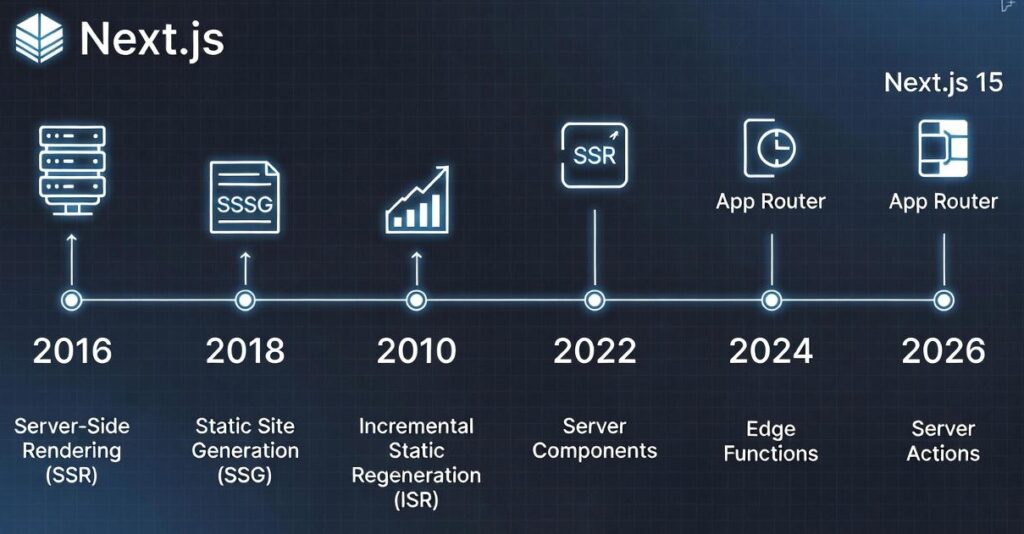
To understand why Next.js has become so dominant, we must look at how it evolved. When Next.js launched in 2016, its core mission was to solve one of the biggest limitations of early React applications — the lack of native server-side rendering. At the time, most React apps were single-page applications rendered entirely in the browser, meaning users had to download large JavaScript bundles before seeing content. This affected SEO ranking, slowed first load, and created accessibility issues for low-powered devices and global networks. Developers who wanted SSR had to manually integrate Express.js, routing, and custom rendering configurations, which was complex and inconsistent across projects. Next.js introduced automatic file-based routing, built-in SSR, and zero-config project structure, giving React developers a structured and production-ready environment for the first time.
As the ecosystem matured, key milestones reshaped the framework. Next.js 9 introduced API routes, turning it into a hybrid frontend-backend system. Next.js 10 brought Image Optimization and Incremental Static Regeneration, allowing static sites to receive real-time content updates without full rebuilds. Between 2023 and 2025, the App Router, React Server Components, streaming rendering, and edge-based execution were introduced — marking one of the most important architectural shifts in modern web development. Instead of rendering everything on the client, logic could now run selectively on the server, at the edge, or on the client, depending on performance needs and interaction design. By 2026, Next.js had transformed from a React enhancement tool into a full-stack, cloud-native application platform used by startups, freelancers, educators, e-commerce businesses, SaaS companies, and enterprise-scale systems worldwide.
Why Developers Are Migrating to Next.js Practical & Real-World Reasons
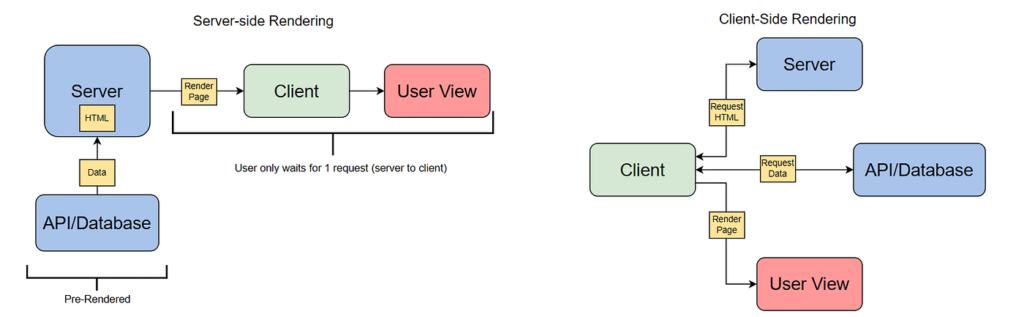
Developers are not switching to Next.js because it is fashionable — they are switching because it solves long-standing real-world development problems. Traditional React applications rely heavily on client-side rendering, which delays content loading, increases bandwidth usage, and shifts too much work onto the browser. This creates a visible lag during first load, especially on mobile networks or older devices. Next.js reverses this behavior by rendering content on the server first, delivering meaningful HTML instantly, and hydrating only the interactive parts of the page. The result is faster first-contentful-paint, better user experience, and improved search engine discoverability. For content platforms, learning resources, business websites, blogging systems, and e-commerce stores, this difference directly impacts traffic, engagement, and conversion.
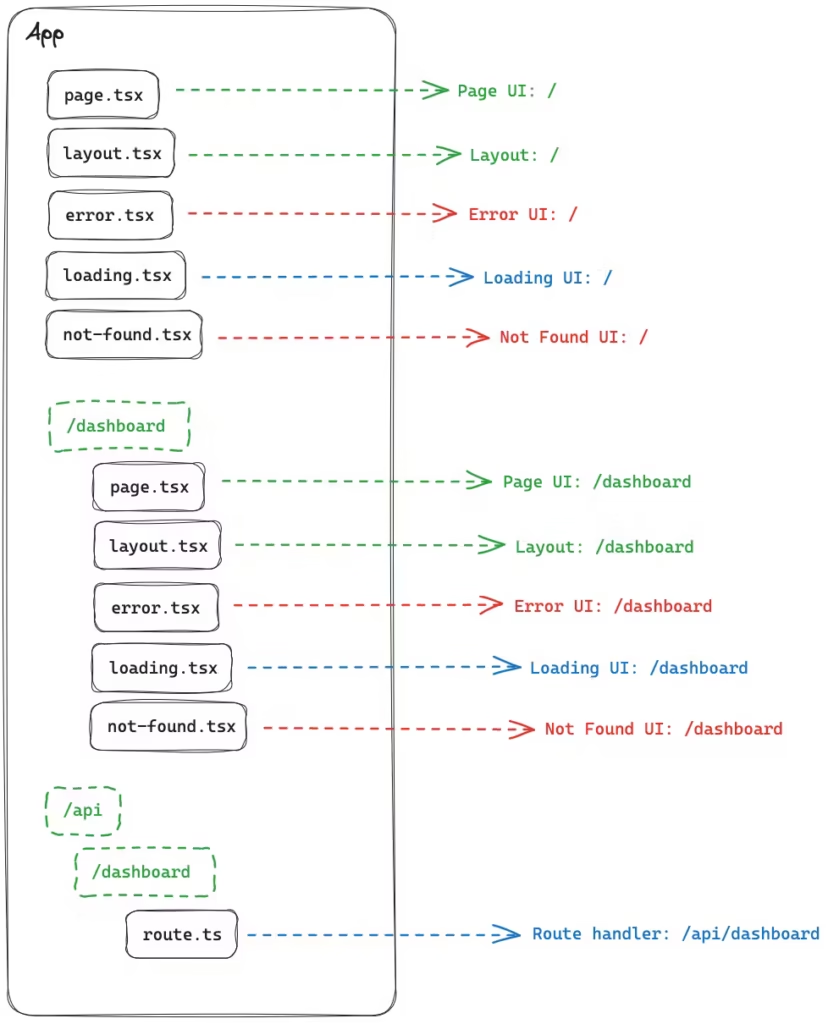
Another reason developers migrate is project organization and architectural clarity. Many beginners struggle to understand where to place components, APIs, routes, and logic in standalone React projects. Next.js enforces a structured file system where each route corresponds to a folder or file, server logic exists in defined boundaries, and data fetching patterns are predictable and consistent. This reduces confusion, encourages cleaner codebases, and accelerates the learning curve for new developers while also supporting large-scale professional applications.
Core Features That Make Next.js the Leading Web Framework in 2026
Next.js succeeds because its features directly align with modern application needs. The framework supports multiple rendering strategies static generation, server-side rendering, streaming, and client interactivity within the same project, letting developers choose the right technique for each page. React Server Components significantly reduce bundle size by executing heavy logic on the server rather than shipping it to the browser. Edge Functions execute requests near users worldwide, lowering latency for global applications. Built-in Image and Font Optimization ensures visual assets load efficiently across devices.
Next.js also offers native SEO optimization, metadata control, Open Graph integration, structured routing, TypeScript support, and automatic code-splitting, removing the burden of manual configuration. Developers benefit from predictable performance improvements and architecture stability without needing third-party tools. The framework is opinionated enough to guide developers toward best practices while still flexible enough to support advanced customization for large systems.
Example: Real-World Data Fetching in Next.js
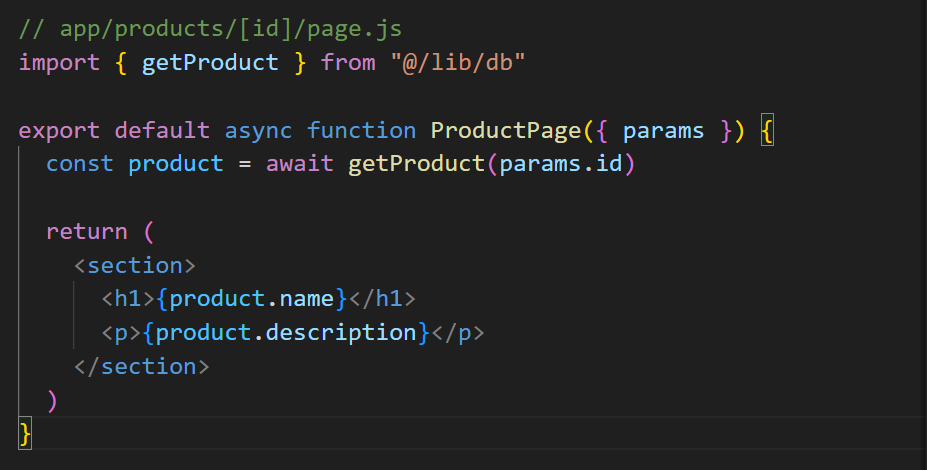
In this example, the page:
- fetches data securely on the server
- renders the UI before sending content to the browser
- avoids exposing database logic on the client
This demonstrates why beginners understand full-stack flow more easily in Next.js than in fragmented multi-tool setups
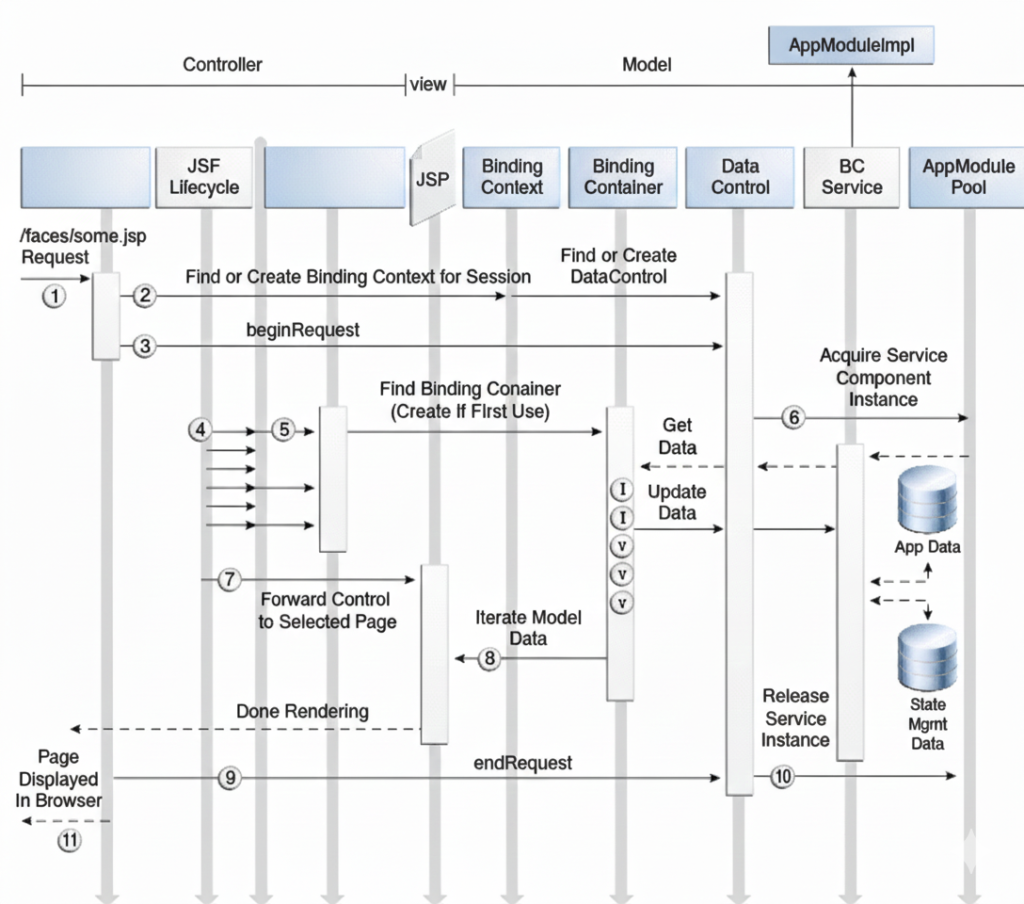
Next.js as a Full-Stack Ecosystem - Not Just a Frontend Tool
Next.js integrates API routes, database connectors, authentication systems, logging tools, and deployment workflows into one environment. Developers no longer need separate Node.js servers or backend frameworks to handle logic. API routes act as lightweight backend endpoints, and with server actions and edge execution, full-stack applications can be built inside a single repository. This reduces complexity, improves maintainability, and makes collaboration easier for teams working on large modular systems. For freelancers and startups, it lowers development cost and time-to-market. For learners, it builds architectural thinking rather than surface-level coding habits.
Performance, SEO & Real-World User Experience Benefits
Search engines prefer pages that load instantly and return meaningful HTML, and this is where Next.js excels. By pre-rendering pages, optimizing images automatically, streaming UI when needed, and delivering assets through global CDNs, Next.js applications rank better, load faster, and provide smoother interaction. Core Web Vitals improve naturally without excessive optimization effort. This makes Next.js ideal for blogs, content platforms, online courses, product showcases, and commercial websites where visibility and engagement matter.
Why Next.js Represents the Future of Web Development
Developers are switching to Next.js in 2026 because it brings together performance, structure, scalability, and full-stack capability inside one unified framework. It simplifies complex workflows, reduces fragmentation across tools, enhances SEO and load performance, and prepares applications for modern cloud-native, server-driven environments. Beginners benefit from clearer architecture and structured learning, while professionals gain stability, speed, and production-ready reliability. Next.js is not a temporary trend — it is a long-term development approach that matches where the web is heading: intelligent rendering, distributed execution, automation-friendly workflows, and deeply integrated full-stack development.