
Client-Side vs Server-Side Rendering
Introduction
Modern web applications are no longer simple static pages they serve thousands (or even millions) of users, load real-time data, support interactive features, and are expected to work seamlessly across devices, networks, and geographical regions. Because of this shift, the way a webpage is rendered has become one of the most important architectural decisions in frontend engineering. Rendering determines how fast users see meaningful content, how Google indexes and ranks pages, how well the site performs on slower devices, and how efficiently the application scales under traffic load. Two primary approaches define this process Client-Side Rendering (CSR) and Server-Side Rendering (SSR). While both approaches display the same UI in the end, they differ dramatically in how content is generated, processed, delivered, and experienced.
Client-Side Rendering became popular with modern JavaScript frameworks like React, Angular, and Vue, where applications behave like interactive software rather than traditional webpages. In CSR, the browser does most of the rendering work, allowing smoother UI transitions and real-time interactions. Meanwhile, Server-Side Rendering gained renewed importance as search engines, performance standards, and Core Web Vitals began prioritizing fast initial content delivery and crawlable HTML output. SSR ensures that users and search engines see meaningful content immediately after loading a page, which makes it ideal for content-heavy and marketing-focused sites.
In real-world production environments, however, rendering is not just a technical concept — it influences user experience, SEO outcome, infrastructure cost, security posture, caching strategy, scalability planning, and application lifecycle maintenance. A rendering strategy chosen without understanding these differences can cause performance bottlenecks, ranking losses, slow loading times, or higher infrastructure usage. This comprehensive article explains CSR and SSR in depth, explores how each approach works internally, analyzes advantages and trade-offs, covers real-world use cases, and discusses the future of hybrid and edge-based rendering enabling developers, students, and software architects to make informed and future-proof architectural decisions.
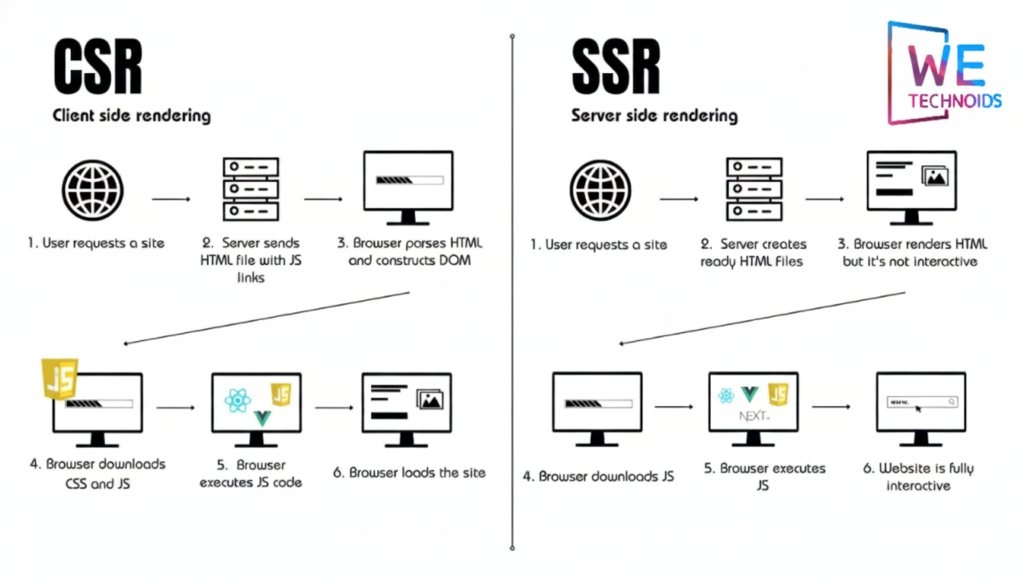
What is Client-Side Rendering (CSR)?
Client-Side Rendering is a rendering model where most UI generation happens inside the user’s browser instead of on the server. When a CSR-based application is requested, the server usually returns a lightweight HTML shell that contains almost no meaningful content by itself. Along with this HTML, large JavaScript bundles are sent to the browser. The browser must then download, parse, and execute those scripts before the user can see the page. After JavaScript initializes, the app loads data from APIs, injects it into components, and finally renders the UI dynamically.
This approach became popular as web applications evolved into Single Page Applications (SPAs) systems designed to behave like desktop or mobile applications. Instead of loading a new page for every action, CSR applications update only required parts of the screen. This creates smooth navigation, instant interactions, transitions, animations, and reactive interfaces powered by state management all executed directly in the browser.
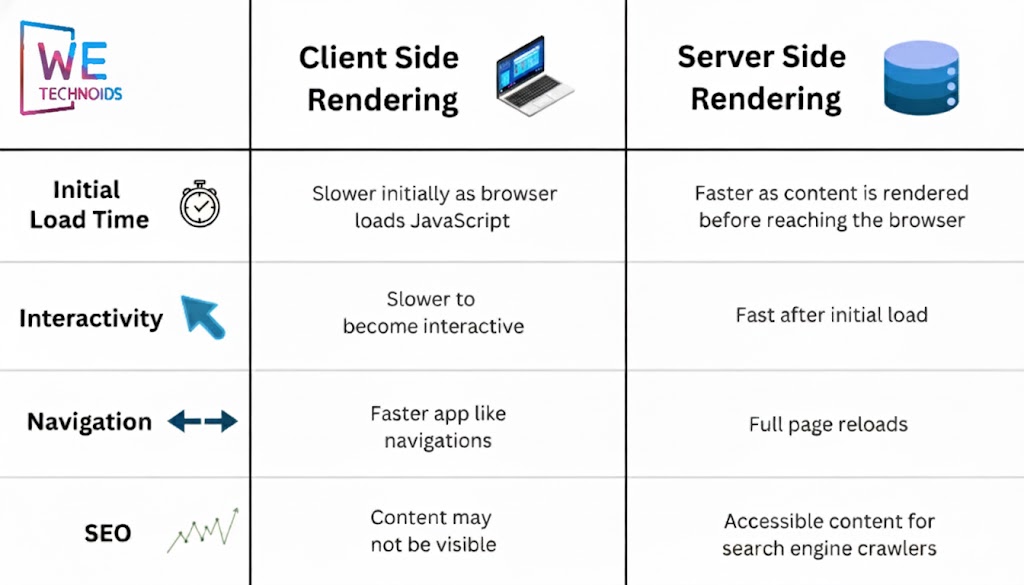
However, CSR also introduces one major challenge the user does not see meaningful content immediately. Before rendering occurs, JavaScript must finish executing, and on slower devices or weak networks, users may experience blank screens, loading placeholders, or delayed content visibility. This makes CSR excellent for interactive environments but demanding in terms of optimization and performance tuning. Still, when configured efficiently, CSR provides a powerful, flexible, and dynamic experience for complex and highly interactive web applications.
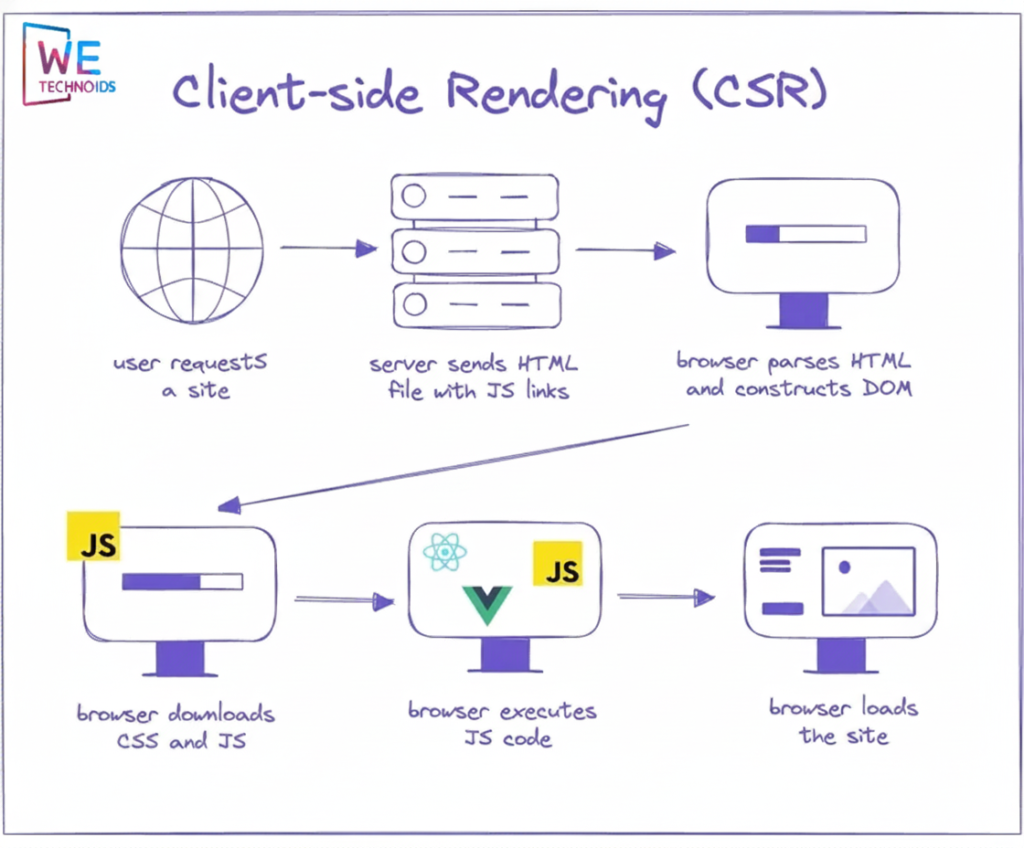
How CSR Works
- The user visits a webpage or app route.
- The server responds with a minimal HTML shell.
- The browser downloads large JavaScript bundles.
- The JavaScript framework initializes the app runtime.
- API calls are made to fetch dynamic data.
- Components receive the data through state or props.
- The UI is constructed and rendered in the browser.
- The app becomes fully interactive after hydration.
Advantages of Client-Side Rendering
Client-Side Rendering is extremely effective in applications where interaction speed, dynamic UI updates, and continuous user activity matter more than initial load time. After the first render, navigation becomes very fast because the browser no longer reloads full pages it simply updates components and internal states.
CSR allows developers to build interactive dashboards, complex UI systems, drag-and-drop tools, customizable workflows, and real-time visualizations. Since most logic runs in the browser, the server handles fewer full-page render requests, reducing backend computation load. CSR also integrates well with offline features using caching and service workers, making it suitable for PWAs and applications with persistent sessions.
The biggest strength of CSR is its ability to create app-like digital experiences, where users interact frequently and remain inside the system for extended periods instead of jumping from page to page.
Limitations of CSR
CSR is not always suitable for performance-critical or SEO-dependent websites. Because rendering requires JavaScript execution, users may experience:
• slow first-time page load
• blank or partially loaded screens
• heavy bundle sizes
• higher memory usage on mobile devices
• degraded performance on low-end hardware
Search engines may also struggle to index CSR pages if they rely on JavaScript-rendered content without prerendering or hydration support.To make CSR applications efficient, developers must use code-splitting, lazy loading, tree-shaking, caching, and bundle optimization techniques otherwise performance issues can escalate in large applications.
What is Server-Side Rendering (SSR)?
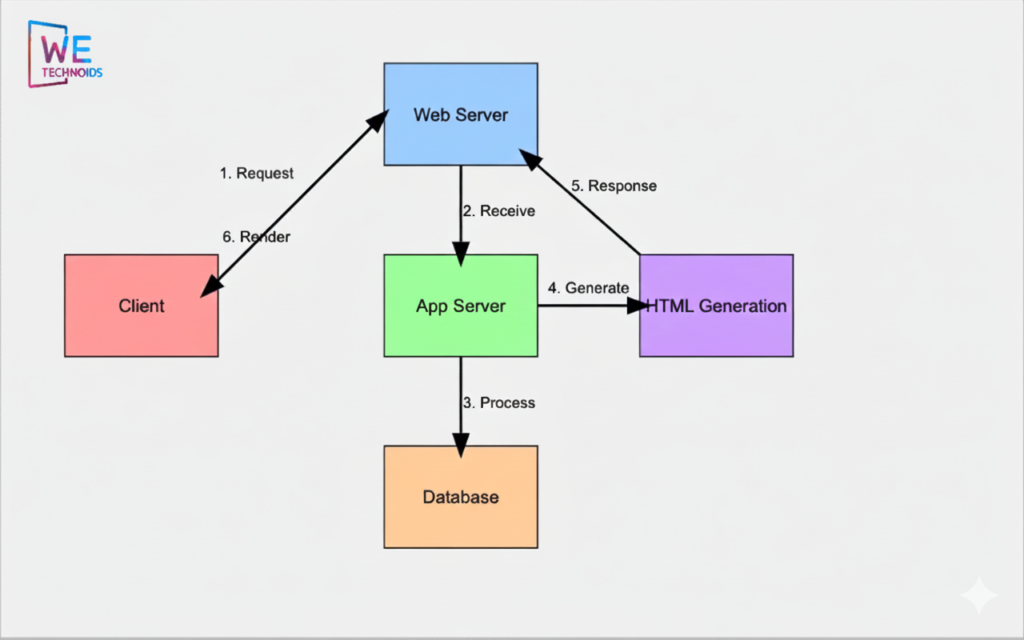
Server-Side Rendering is a rendering approach where most of the page’s HTML is generated on the server before being delivered to the browser. When a request is made, the server processes the application logic, fetches data from APIs or databases, executes templates or components, and produces a fully rendered HTML document. The browser receives this complete page instantly, meaning users can see content immediately even before JavaScript finishes loading.
Modern frameworks like Next.js, Nuxt.js, Remix, and SvelteKit have modernized SSR by combining it with hydration, where JavaScript activates interactivity after content is already visible. This approach significantly improves Time-to-First-Paint (TTFP) and Largest Contentful Paint (LCP), which are core performance metrics in modern web optimization.
SSR is especially powerful for websites where first impression, load speed, SEO ranking, and accessibility play a major role. Content-driven sites, e-commerce platforms, and marketing pages benefit significantly because users and search engines receive readable content immediately instead of waiting for JavaScript execution.
How SSR Works
- The user requests a webpage.
- The request is sent to the application server.
- The server fetches required data from APIs or databases.
- A full HTML page is rendered on the server.
- The HTML is returned to the browser.
- The user instantly sees meaningful content.
- JavaScript loads afterward to enable interactivity.
- Hydration activates dynamic UI elements.
Advantages of SSR
SSR provides strong benefits for websites where fast visibility, SEO performance, and accessibility define success. Users see meaningful content immediately, which lowers bounce rate and improves engagement especially on slow networks. Since pages are already rendered in HTML, search engines can crawl them easily without requiring JavaScript execution.
SSR also performs better on low-end mobile devices because less processing is required in the browser. This makes it ideal for sites that expect a wide range of user hardware environments.
For businesses focused on growth, marketing, and discoverability, SSR contributes directly to higher visibility and conversion performance.
Trade-Offs & Challenges of SSR
However, SSR also has its own challenges:
• higher load on backend servers
• more complex deployment and scaling
• slower in-app navigation compared to CSR
• requires efficient caching layers
• potential bottlenecks under traffic spikes
To maintain performance, SSR systems must include CDN caching, edge rendering, and load balancing, especially at enterprise scale.
CSR vs SSR
Real-World Use Cases
CSR works best in interactive, application-like systems where users frequently interact with the interface after initial load. This includes SaaS dashboards, reporting platforms, web-based tools, real-time collaboration systems, chat and messaging interfaces, code editors, data visualization tools, and enterprise admin panels. In these environments, users spend long periods inside a single interface, performing repeated actions, switching between views, and interacting with constantly updating content. Here, CSR provides smoother navigation and lower latency during interactions, making it the more suitable architecture.
SSR works best in content-focused and SEO-driven platforms, including e-commerce websites, blogs, article platforms, content portals, magazine sites, marketing websites, portfolio and brand pages, and knowledge or documentation libraries. These websites rely heavily on search visibility, ranking performance, and first-load responsiveness. Since many users arrive through search results, fast content delivery determines engagement and retention. SSR ensures that structured content loads instantly, supports accessibility standards, and remains readable even before JavaScript loads which greatly benefits usability and ranking.
Modern Hybrid Rendering - The Future of Web Architecture
The web is no longer limited to choosing only CSR or SSR. Modern frameworks increasingly adopt hybrid rendering architectures, where each page or even individual components can use different rendering strategies based on usage patterns. Static Site Generation (SSG) allows rarely-changing pages to be prebuilt and served instantly. Incremental Static Regeneration (ISR) updates specific pages when content changes rather than rebuilding the entire site.
Streaming SSR allows servers to send HTML in chunks, letting users see content even faster. Edge Rendering pushes computation closer to the user through CDN edge nodes, reducing latency for global audiences. Partial hydration and islands architecture reduce JavaScript overhead by hydrating only interactive parts of a page instead of hydrating the entire document.
This hybrid approach ensures that every page receives the most appropriate rendering model depending on:
• update frequency
• SEO importance
• content type
• geographic audience
• device class
• performance constraints
As a result, modern websites achieve both high performance and scalability rather than compromising between them.
Key Architectural Insights for Developers
CSR is best suited for highly interactive applications, while SSR is best for content-centric and SEO-driven platforms. Rendering strategy directly influences UX quality, infrastructure efficiency, device compatibility, and business outcomes. The most future-ready approach is not choosing one model permanently, but learning how to combine CSR, SSR, SSG, ISR, and edge rendering intelligently based on practical needs instead of theoretical preference.
Developers who understand rendering deeply can design systems that scale gracefully, perform consistently under real-world conditions, and deliver stronger results to users and businesses alike.
Conclusion
Client-Side Rendering and Server-Side Rendering are not competing technologies they are complementary architectural tools designed for different types of applications. CSR enables powerful, interactive, application-like web experiences, while SSR delivers faster content visibility, stronger SEO performance, and broader accessibility support. The smartest development approach is to treat rendering strategy as a context-driven architectural decision, selecting or combining rendering models based on user behavior, performance goals, and long-term scalability requirements.
As the web continues to evolve, hybrid and edge-based rendering models will shape the next generation of high-performance, globally scalable web platforms and developers who understand these concepts will be better equipped to build reliable, future-ready digital experiences.