Revolutionizing Modern Software Development
Introduction
AI Pair Programming represents one of the most transformative innovations in the history of software engineering. As software systems grow more complex and the demand for faster delivery increases worldwide, developers have continually sought tools and methodologies that improve productivity, reduce errors, and enhance learning. Traditional pair programming where two developers sit together, discuss logic, and code collaboratively has long been valued in agile teams because it improves quality through real‑time peer review and shared problem solving. However, it has limitations related to human availability, varying expertise levels, and collaboration overhead. The emergence of artificial intelligence (AI) has ushered in a new paradigm: AI Pair Programming, where machine intelligence partners with human developers as an ever‑present, highly capable coding assistant. AI Pair Programming tools analyze context, interpret natural language prompts, generate code, identify bugs, suggest optimizations, and even draft documentation all within the developer’s workflow. Rather than replacing developers, these AI systems augment human capability, enabling engineers to focus on high‑level design, critical thinking, and creative problem solving. Across industries from startups to Fortune 500 enterprises organizations are adopting AI Pair Programming to accelerate delivery cycles, improve code quality, and democratize access to best‑practice programming patterns. As we explore this topic in depth, we’ll examine how AI Pair Programming works, its core features, real‑world use cases, differences from traditional pairing models, challenges, future trends, and the implications for the broader tech ecosystem.
How AI Pair Programming Works
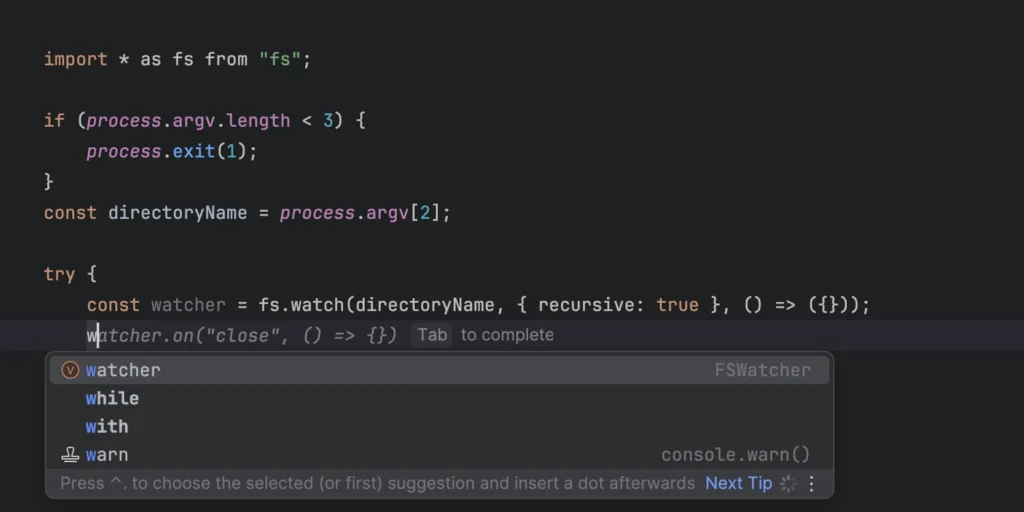
AI Pair Programming tools are powered by large language models (LLMs) trained on vast repositories of code, documentation, and natural language. These models combine natural language understanding with code synthesis capabilities, enabling them to interpret developer intent expressed in comments or prompts and generate corresponding code that fits the existing project context.
Core Technical Mechanisms
- The AI analyzes open project files, variable names, function signatures, and comments to maintain consistency with existing code.
- Developers can write plain English requests (e.g., “create a validation function for user input”) and receive accurate code implementations.
- Rather than simple autocomplete, AI predicts entire blocks of code, functions, or modules, tailored to the prompt and existing logic.
- Many tools adapt to a developer’s coding style over time, improving suggestion relevance.
- Accepting or rejecting suggestions trains the AI to refine future prompts.
Key Features of AI Pair Programming Tools
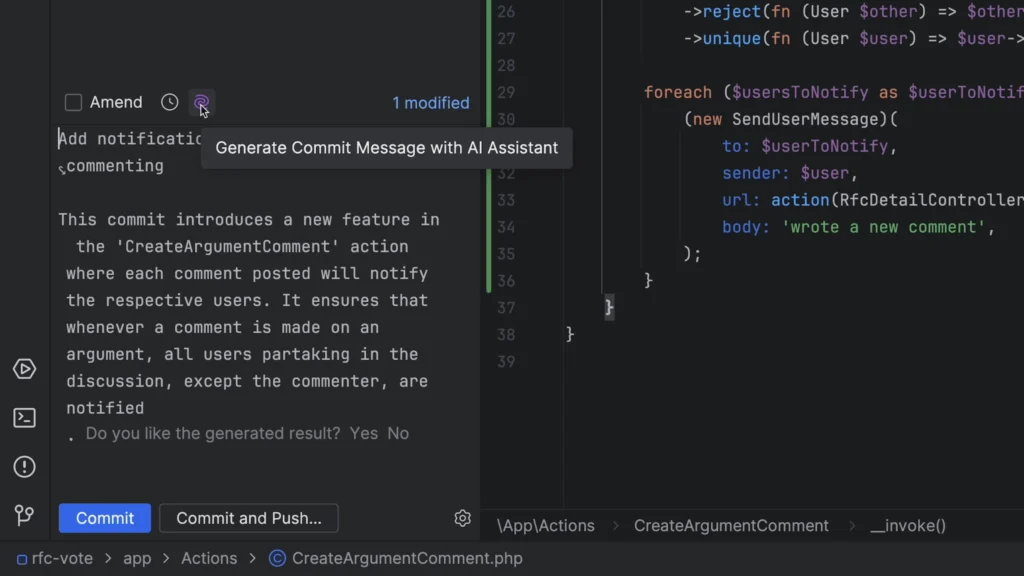
- Intelligent Code Generation
AI can produce complete functions or modules from high‑level descriptions, eliminating the need to write repetitive boilerplate code manually. This accelerates development and reduces manual errors. - Real‑Time Error Detection & Debugging
AI tools can identify syntax errors, logical issues, and even performance bottlenecks, offering suggestions to fix them mid‑development. - Documentation and Explanation
Beyond generating code, AI can produce inline explanations, docstrings, and comprehensive documentation, helping teams maintain clarity and onboarding new developers faster. - Test Case Generation
AI can suggest unit tests, integration tests, and edge case coverage automatically, strengthening software quality assurance with minimal manual effort. - Multi‑Language Support
Modern tools support a wide range of languages such as Python, JavaScript, Java, C++, Go, Rust enabling teams to use AI across diverse tech stacks. - Semantic Code Refactoring
AI can recognize opportunities to restructure code for better readability, maintainability, and performance without changing its behavior.
Benefits of AI Pair Programming
Boosted Developer Productivity
AI reduces the time spent on repetitive and error-prone tasks, enabling developers to focus on high-level problem-solving. Enterprise applications often involve standard processes like authentication, input validation, and data serialization, which consume significant time. By automating these routines, AI can reduce development cycles by 30–50%, letting teams deliver faster while maintaining quality.
Industry Example: A fintech company using GitHub Copilot reported that developers were able to implement new financial transaction features 40% faster, allowing more time to focus on risk modeling and fraud detection.
Accelerated Learning and Skill Growth
For beginners and junior developers, AI acts as a real-time tutor. It provides inline explanations, code examples, and alternative implementations, helping learners understand both how and why certain patterns are used.
Industry Example: In coding bootcamps teaching React and Node.js, students leveraging AI Pair Programming could grasp complex concepts like lifecycle methods, state management, and asynchronous operations faster than traditional instruction.
Higher Code Consistency
Maintaining uniform code standards across large teams is challenging. AI enforces consistency by generating code following predefined patterns, formatting rules, and architectural conventions.
Industry Example: Large companies with multiple microservices teams use AI-generated suggestions to maintain consistent APIs, logging formats, and error handling across hundreds of services, reducing integration issues and onboarding time.
Real‑World Industry Examples
GitHub Copilot in Agile Teams
Many software teams integrate GitHub Copilot directly into Visual Studio Code to accelerate feature development. Copilot suggests context‑aware code snippets, tests, and documentation, enabling faster sprint deliveries. Large tech companies report noticeable reductions in routine coding time, allowing engineers to focus on architectural decisions.
AI in Data Science Workflows
Data scientists use AI assistants to generate data preprocessing pipelines, exploratory analysis code, and model creation scripts. Tools like ChatGPT’s Code Interpreter help translate analytical requirements into executable Python code, saving analysts hours per task.
Enterprise DevOps Integration
Some enterprises integrate AI into CI/CD pipelines. AI-generated test suites, code coverage suggestions, and automated refactoring reduce deployment risks and improve resilience in production systems.
AI Pair Programming vs. Traditional Pair Programming
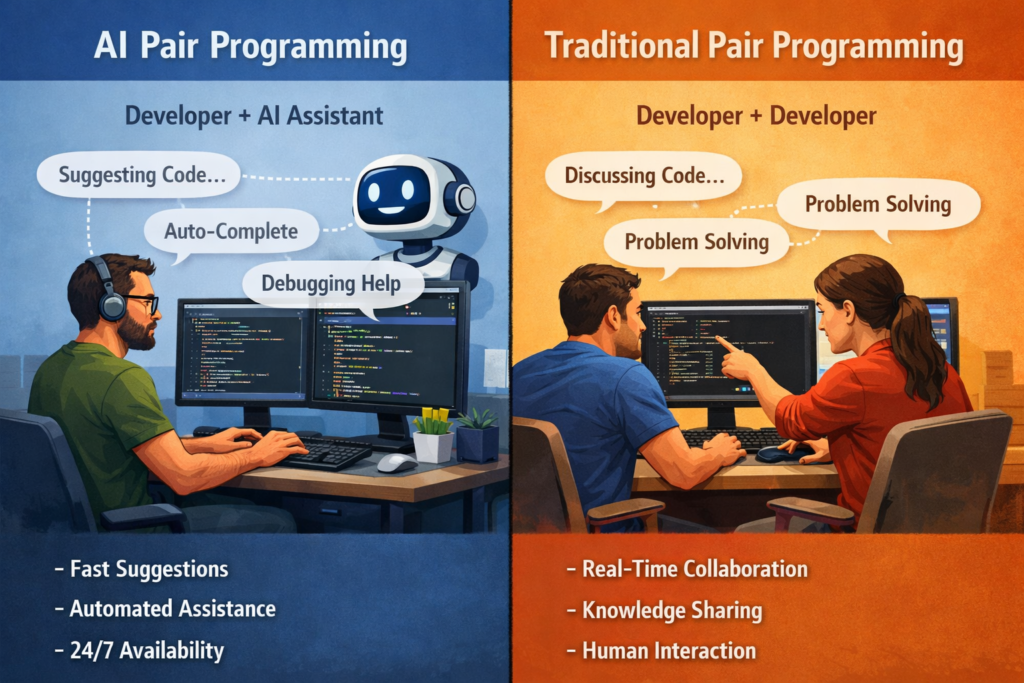
Comparative Insights
Although traditional pair programming emphasizes human collaboration and shared reasoning, AI Pair Programming excels in scalability, speed, and continuous availability. The human element remains critical for high‑level design, communication, and ethical considerations.
Challenges & Risks
- Over-Reliance and Skill Atrophy
- Security and Privacy Concerns
- Inaccurate or Suboptimal Code
- Licensing and Ethical Issues
Future Outlook of AI Pair Programming
- Enhanced Context and Memory
AI will retain deeper project knowledge over long periods, generating context-aware suggestions across multiple files and sessions. - Multi-Modal Interaction
Voice-based coding, conversational debugging, and high-level natural language design discussions will become mainstream. - Full-Stack Suggestion Engines
AI will propose not just code but entire architectural patterns, database schemas, and scalable infrastructure solutions. - Autonomous Testing & Deployment Assistants
AI will automatically update tests, suggest optimizations, and integrate changes into CI/CD pipelines. - Ethical and Governance Layers
Teams will adopt compliance and governance tools to ensure AI-generated code meets security, licensing, and architectural standards.
Conclusion
AI Pair Programming is not merely a productivity tool; it is reshaping how software is designed, taught, and built. By combining machine precision with human ingenuity, AI enables developers to write better code faster, reduce errors earlier, and focus on high‑impact problem solving rather than low‑value repetition. While challenges remain especially around security, ethics, and reliance the future of software development is increasingly collaborative: humans and artificial intelligence working together to unlock new levels of creativity and efficiency.