
WebAssembly for Web Developers
WebAssembly has become one of the most influential technologies shaping the modern web development ecosystem. Traditionally, the web relied heavily on JavaScript as the primary execution language inside the browser, which worked well for UI interactions, animations, and application logic. However, as the web evolved, developers began building complex applications such as 3D modeling tools, browser-based games, machine learning interfaces, data visualization platforms, and video editing systems all of which require significantly higher computational power than JavaScript alone could consistently deliver. This is where WebAssembly enters the picture as a powerful solution that enables near-native performance within the browser while maintaining web security standards and platform independence.
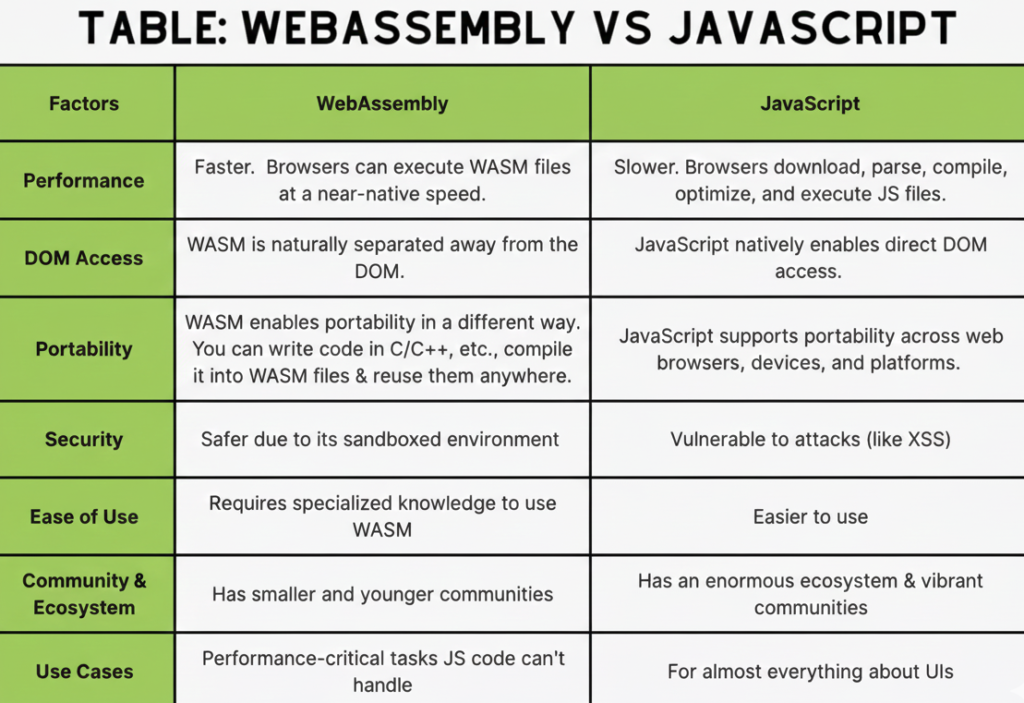
Rather than replacing JavaScript, WebAssembly complements it by handling heavy computational workloads, mathematical operations, and performance-sensitive logic. JavaScript remains responsible for managing user interactions, DOM manipulation, event handling, and application state while WebAssembly executes intensive processing in a highly optimized binary format. This collaboration creates a more capable, scalable, and high-performance web ecosystem where applications that once required native desktop software can now run smoothly inside the browser without installing separate executables or plugins.
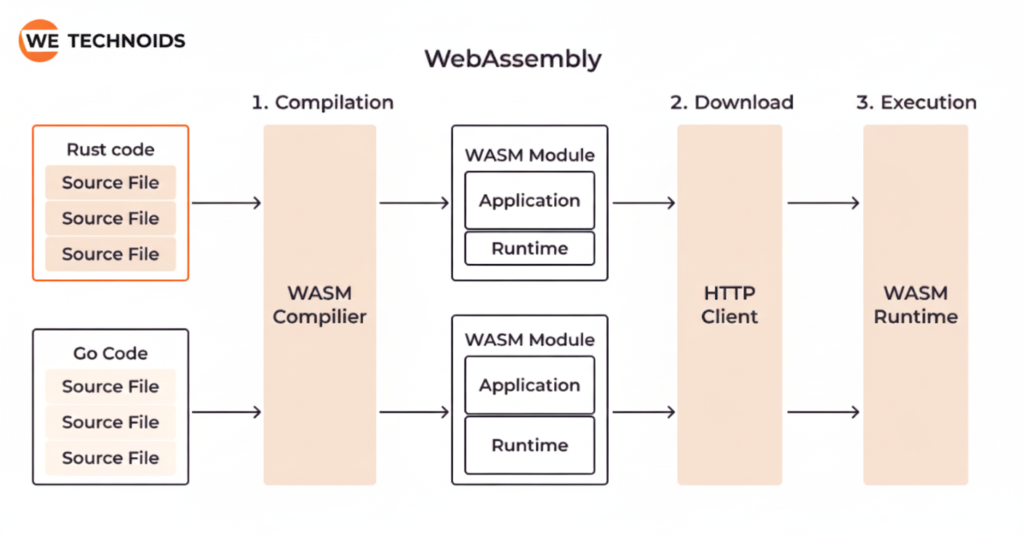
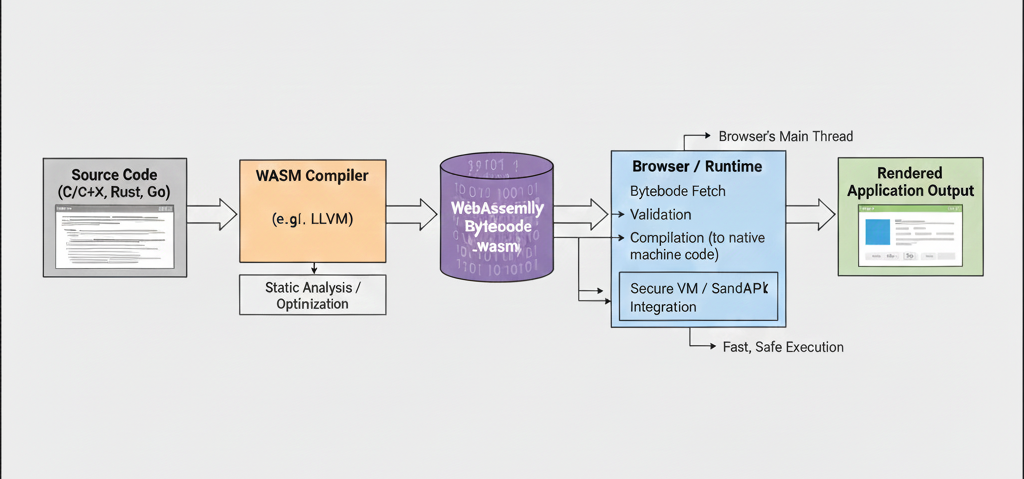
WebAssembly is supported across all major browsers and modern runtimes, making it a widely adopted and future-oriented standard. It allows developers to compile languages such as C, C++, Rust, Go, and C# into WebAssembly modules, which execute within a secure sandboxed environment. This enables teams to reuse existing native codebases, port legacy applications to the web, and build entirely new categories of browser-based tools without sacrificing performance. Instead of interpreting code dynamically like JavaScript, WebAssembly runs pre-compiled binary instructions, resulting in faster execution, predictable performance behavior, and reduced overhead for complex applications.
Understanding WebAssembly at a Deeper Technical Level
WebAssembly (Wasm) is a low-level binary instruction format designed to be executed at high speed inside the browser, but it is also intentionally structured to remain portable, memory-safe, and secure. Unlike earlier browser plugins such as Flash, Silverlight, or Java Applets, WebAssembly is not an external extension it is a native web standard integrated directly into modern browsers.
When a WebAssembly module is loaded, the browser validates and executes it through a dedicated runtime environment, preventing unauthorized access to system resources. The execution is deterministic and optimized for performance, meaning applications behave consistently across devices, operating systems, and browsers. This makes WebAssembly suitable not only for performance-intensive applications but also for enterprise-grade systems where reliability and predictability are critical requirements.
One of the most powerful aspects of WebAssembly is its ability to interoperate seamlessly with JavaScript. Developers can call WebAssembly functions from JavaScript and vice versa, allowing applications to split workloads intelligently. For example, UI logic may remain JavaScript-driven, while complex calculations such as image processing, scientific computation, or cryptographic operations are executed in WebAssembly. This hybrid execution model helps developers achieve better application performance without sacrificing usability or maintainability.
Why WebAssembly is Important for Modern Web Applications
As web applications grow more advanced, performance expectations also increase. Users now expect real-time responsiveness, smooth animations, fast rendering, and interactive features without delays or lag. Traditional JavaScript engines are extremely powerful, but they are still optimized for flexibility rather than raw computational efficiency. When applications start processing large data sets, running AI inference, or performing CPU-heavy tasks, the limitations of interpreted execution become noticeable.
WebAssembly bridges this performance gap by offering a low-level execution layer that behaves similarly to native machine code while remaining safely sandboxed. It is particularly useful in industries where browser applications must emulate or replace native desktop tools. Engineering platforms, design software, developer IDEs, financial analytics dashboards, and multimedia production tools are increasingly shifting toward web-based delivery models and WebAssembly enables that transition without compromising performance or user experience.
Another major advantage is software portability. Existing C++ or Rust codebases that have been maintained for years can now be compiled into WebAssembly and reused in web applications. This significantly reduces redevelopment costs and allows organizations to modernize legacy systems far more efficiently. In addition, startups and SaaS products can deliver powerful tools directly through the browser, reducing installation friction and improving accessibility for users worldwide.
Real-World Applications Where WebAssembly Excels
In real production environments, WebAssembly is proving especially valuable in domains that require real-time processing and heavy computation. Game engines, simulation platforms, and immersive 3D applications benefit from WebAssembly because rendering, physics calculations, and motion handling require consistent high-speed execution. Many development studios now compile native engines to WebAssembly, allowing users to play fully interactive experiences directly in the browser with performance comparable to desktop builds.
Scientific and analytical tools also rely on WebAssembly for complex numerical processing. Data scientists, engineers, and researchers can run simulations, modeling algorithms, and visualization engines directly in web platforms without installing specialized software. This makes collaboration easier, improves deployment flexibility, and allows projects to run across multiple devices and environments.
Browser-based media applications including image editors, video processing tools, and digital audio workstations leverage WebAssembly to accelerate rendering and transformation operations. Tasks such as encoding, filtering, and compression can be handled much more efficiently compared to traditional script-only implementations. Similarly, AI inference and machine-learning workloads can run locally in the browser, reducing latency, protecting user privacy, and enabling offline-capable intelligent applications.
Advantages WebAssembly Brings to Web Developers
From a developer perspective, WebAssembly enables high performance while maintaining the benefits of web-based delivery. It allows reuse of proven native libraries, encourages modular architecture, and opens opportunities for cross-platform software migration. Because WebAssembly is secure, standardized, and broadly supported, it forms a reliable foundation for building advanced browser-based systems.
It also encourages better application design practices. Developers can architect applications where each layer is responsible for specific functionality JavaScript for interaction, WebAssembly for computation, and Web APIs for rendering and hardware acceleration. This structured division increases maintainability and scalability as projects grow.
Practical Challenges Developers Should Be Aware Of
Despite its strengths, WebAssembly also introduces engineering challenges that must be approached carefully. Debugging compiled binaries can be more complex than debugging JavaScript code, and memory management becomes critical in languages such as C or C++. Bundle size must be optimized to avoid slow loading, and developers need to choose wisely when WebAssembly is necessary as not every application requires it.
In other words, WebAssembly is most effective when used with intention specifically for workloads where performance or computational intensity truly justifies it.
The Future Direction of WebAssembly in Software Development
WebAssembly is rapidly evolving beyond the browser environment. With the introduction of WASI (WebAssembly System Interface), Wasm modules can now run on servers, edge platforms, IoT devices, and lightweight container alternatives. This opens doors to portable execution environments, secure sandboxed microservices, and distributed computing architectures. In the coming years, WebAssembly may play a central role in:
• serverless execution
• edge computing networks
• secure plugin ecosystems
• portable cloud runtimes
• cross-platform application engines
Developers who understand WebAssembly concepts today will gain a significant advantage as the ecosystem matures and expands across new computing environments.